Solar PV
TIS 9000 Review: Is This the Ideal Tester for Solar PV Installers?
An approved voltage indicator for safe isolation, a 200 A AC/DC current tester and a handy collection of fault-finding functions. We put the TIS 9000 through its paces on a working solar installation to see whether one instrument really can do the job of several.

Solar panels have a nasty habit
Solar panels have a rather irritating habit of producing electricity whenever the sun comes out. You can switch off the inverter, isolate the AC supply and congratulate yourself on a job well done, but those panels are still sitting on the roof generating hundreds of volts DC.
And if you decide to pull apart an MC4 connector while current is flowing, things can get spectacular. Unfortunately, not in a good way.
Unlike AC, which helpfully passes through zero every half-cycle, DC doesn't offer the same opportunity for an electrical arc to extinguish itself. Separate two contacts under load and you could be rewarded with a sustained arc, damaged connectors and a very bad afternoon.
It's why conventional solar PV connectors aren't designed to be disconnected under load.
But that raises an interesting question. How do you know whether there's actually any current flowing?
Enter the TIS 9000, an AC/DC open-jaw multi-tester from Test Instrument Solutions.
What makes this instrument interesting isn't simply its ability to measure DC current. It's also an approved two-pole voltage indicator for safe isolation, with a collection of measurement functions useful on both sides of a solar inverter.
In other words, the sort of instrument that could save electricians from carrying half the contents of their test equipment cupboard around with them.
We put it to work on a real solar installation to see what it could do.
When isolation isn't quite as straightforward as it looks
On a relatively simple solar installation, things are straightforward. You know which strings connect to which inverter, and you can isolate the AC and DC sides before starting work.
But move to a larger site with multiple inverters, dozens of strings and cables disappearing into junction boxes, and things can get considerably more complicated.
It's surprisingly easy to lose track of what's connected to what. And that's when you risk pulling apart an MC4 connector with a sizeable DC current still flowing through it.
I know, because I've done it. And it's a mistake I'm not keen to repeat.
That's where the TIS 9000's open-jaw DC current measurement becomes particularly useful.
Without disturbing the conductor, you can check whether current is flowing. On our installation, we measured approximately 2.4 amps before shutting down the system. After operating the AC and inverter DC isolation devices, the reading dropped to zero.
Of course, zero current doesn't mean zero voltage. A solar array exposed to daylight can still be generating hundreds of volts DC, even when there's no load current flowing.
A zero-current reading is therefore a useful additional check, not permission to start disconnecting things. Correct circuit identification, suitable isolation and the manufacturer's instructions remain essential.
But how do you know the tester isn't lying?
There's one more thing to consider. What if the tester says zero because it's stopped working?
This is a problem addressed in BEAMA's September 2026 technical bulletin on DC PV connectors.
The guidance recommends checking a DC clamp meter on a conductor carrying current before relying on it to confirm that current has stopped following isolation.
That way, you know the instrument is responding before trusting a zero reading.
The TIS 9000 has a rather neat alternative: a supplied proving magnet that allows you to check the response of its DC current sensor before and after measurement.
It means you can check that the sensor responds without having to find another conductor carrying current.
That's particularly useful on larger installations where identifying a suitable energised string may not be straightforward.
The magnet offers an additional means of checking the sensor, although BEAMA does not specifically endorse it as an equivalent to the current-carrying conductor check.
It's a small feature that addresses a very real testing problem.
Further reading:BEAMA Technical Bulletin: DC PV Connectors
An approved voltage indicator with a lot more up its sleeve
Here's where the TIS 9000 becomes particularly interesting.
Every electrician carrying out safe isolation should have a suitable two-pole voltage indicator. And while a conventional multimeter might tell you the voltage, it isn't necessarily suitable for establishing that a circuit is dead.
The TIS 9000 complies with IEC 61243-3:2014, the standard covering two-pole voltage detectors, and is suitable for safe isolation on conventional AC installations when used with an appropriate proving unit.
Its voltage indication and measurement capabilities are also useful on the DC side of solar PV installations, within the manufacturer's specified operating limits.
So rather than carrying separate instruments for voltage indication, current measurement and basic fault-finding, electricians can tackle a surprising number of tasks with the TIS 9000.
You still need an appropriate proving unit for safe isolation, but the tester itself can cover many of the everyday measurements before it's time to break out the specialist equipment.
It even works without batteries
A voltage tester that stops indicating dangerous voltage because its batteries have gone flat would be rather like a smoke alarm that only works when there's no fire.
Fortunately, the TIS 9000 has another trick.
It incorporates a battery-independent voltage indication function.
We removed the batteries and applied both AC and DC voltage. The tester continued to indicate the presence of voltage.
That provides an additional safeguard against a misleading absence-of-voltage indication, although it doesn't remove the requirement to prove the instrument before and after use.
The battery-independent function must also be used within its specified operating limits.
More than a current clamp
There's plenty more packed into the TIS 9000.
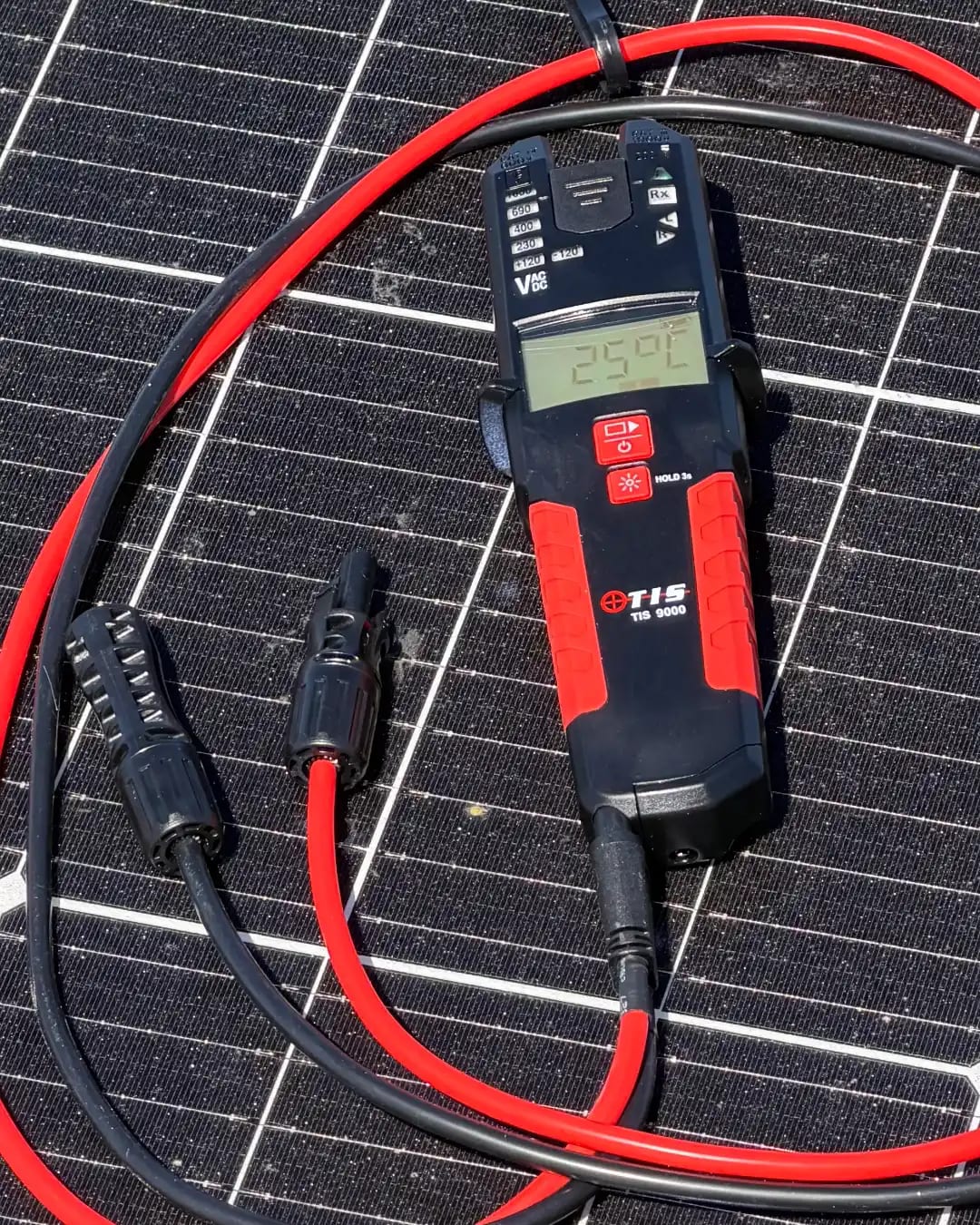
One of the most practical features for solar installers is the interchangeable test lead arrangement. Swap the standard probes for compatible MC4 test leads and you can connect directly to solar strings for voltage and polarity checks.
With voltage measurement up to 1,500 V DC and 1,000 V AC, the instrument covers a wide range of applications, subject to its measurement category and test lead ratings.
The open jaw measures up to 200 A on both AC and DC circuits, making it useful for checking current draw, investigating faults and taking quick measurements without breaking into a circuit.
There's also resistance, continuity, frequency and phase rotation testing, together with a built-in torch.
An AC non-contact voltage detector provides another useful preliminary check, although it must never be relied upon for proving a circuit dead.
And there's even an ambient temperature indicator. Not particularly useful for electrical testing, admittedly, but perfect for reminding your colleagues back at base that you're enduring a sweltering 36°C on the roof, while they're struggling with the office thermostat set to 21°C.
TIS 9000 specifications
| Feature | Specification |
|---|---|
| AC voltage | Up to 1,000 V |
| DC voltage | Up to 1,500 V |
| AC/DC current | Up to 200 A |
| Current measurement | 14 mm open jaw |
| Voltage indication | IEC 61243-3:2014 two-pole function |
| Test leads | Interchangeable standard and compatible MC4 leads |
| Additional voltage detection | AC non-contact and single-pole |
| Other measurements | Resistance, continuity, frequency, phase rotation |
| Additional features | Proving magnet, torch, ambient temperature indication |
| Ingress protection | IP64 |
| Measurement category | CAT III 1,000 V / CAT IV 600 V |
Always consult the manufacturer's instructions for measurement limits, test lead ratings and the operating conditions of the voltage indication functions.
TIS 9000 versus TIS 8000: what's changed?
If you're familiar with the earlier TIS 8000, the new instrument might look rather familiar.
Both combine a voltage indicator suitable for safe isolation with several everyday electrical measurement functions.
The big difference for renewable energy work is DC current measurement.
The TIS 8000 measures current on AC circuits up to 200 A, while the TIS 9000 extends that capability to DC.
The proving magnet and MC4 test lead arrangement add to its usefulness for solar PV work.
If you spend your days working exclusively on conventional AC installations, the earlier instrument may already do everything you need.
But for electricians increasingly involved in solar PV, battery storage and other DC systems, the additional functionality makes an interesting proposition.
Our verdict
The TIS 9000 isn't going to replace every instrument in an electrician's toolbox.
You'll still need dedicated test equipment for insulation resistance measurements, full installation verification and specialist solar PV commissioning.
But the appeal here is versatility.
At its heart, the TIS 9000 is an approved two-pole voltage indicator for safe isolation, with the added ability to measure AC and DC current and carry out a wide range of everyday diagnostic checks.
With an appropriate proving unit, electricians can follow established safe isolation procedures on suitable circuits, then use the same instrument for quick measurements and fault-finding.
For those moving between conventional AC installations, solar arrays and battery storage systems, that's an attractive combination.
And when it comes to disconnecting PV connectors, the ability to verify that current has stopped flowing, and check that the current sensor is responding, is particularly welcome.
Because guessing is a remarkably poor method of electrical testing.
Find out more
For full product specifications, visit Test Instrument Solutions.